Missouri Medicaid Billing For Home Care Providers
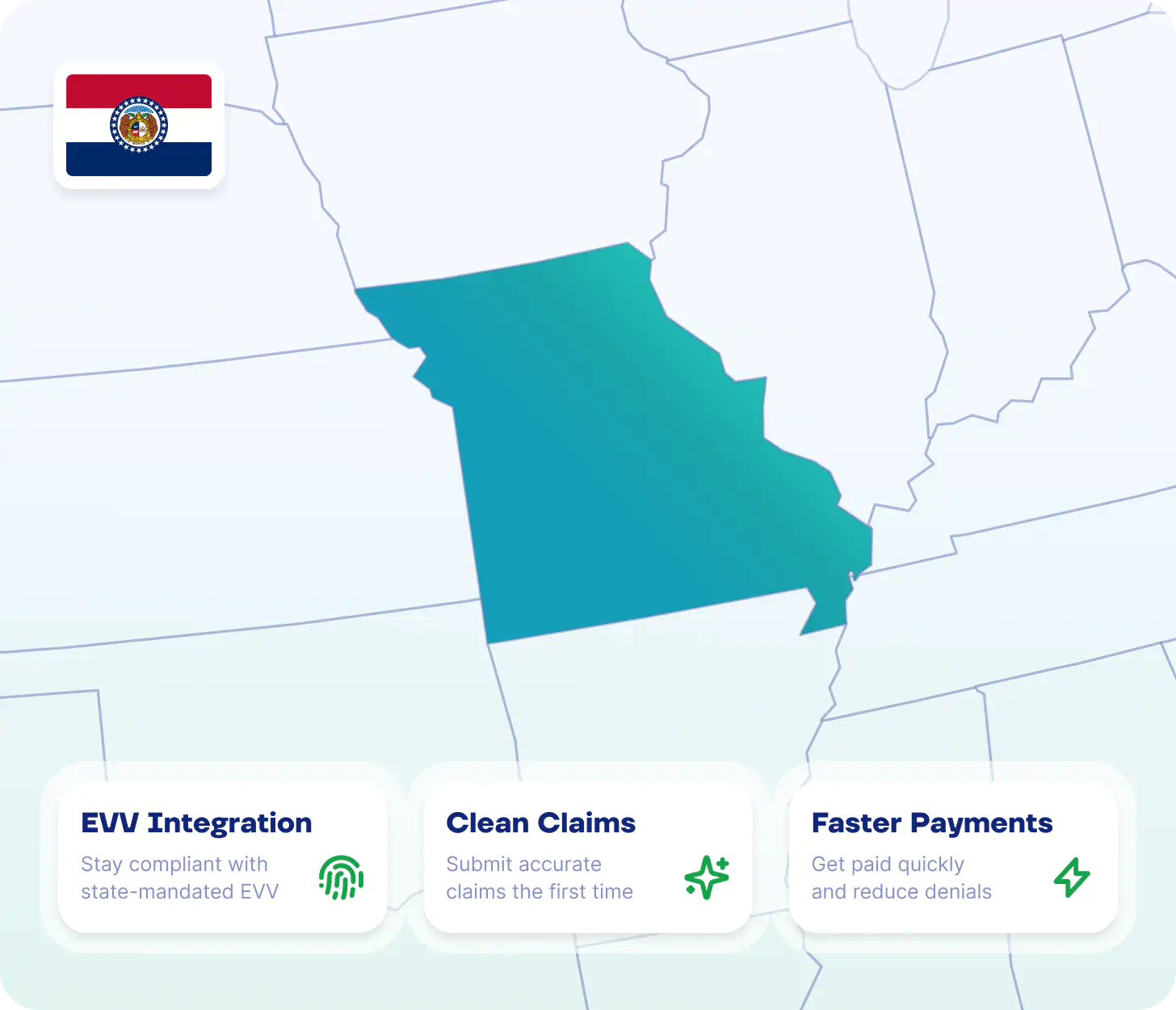
This page provides an overview of Missouri programs, waivers, payers, and EVV requirements relevant to home care (non-medical) providers operating in the state of Ohio.
Electronic Visit Verification
Missouri requires EVV for most Medicaid-funded personal care and home health aide services. Clean, timely visit data is critical - any issues in EVV can result in denied or delayed payments.
Sandata
Open Model
Hard edits implemented on April 1, 2026


Programs & Waivers
State Plan
- In-Home Services (IHS)
- Consumer Directed Services (CDS)
Division of Senior and Disability Services
- MO Aged and Disabled Waiver
- MO Independent Living Waiver
- MO Structured Family Caregiving Waiver
Bureau of HIV, STD, and Hepatitis
MO Brain Injury Waiver
Department of Mental Health
- MO Children with Developmental Disabilities (MOCDD) Waiver
- MO Developmental Disabilities (DD) Waiver
- MO Division of Developmental Disabilities Community Support Waiver
Payers
MO HealthNet
Programs & Waivers
Payers
Frequently Asked Questions
Yes. Missouri requires EVV for Medicaid-funded personal care and home health services provided in the home. Providers must comply with state EVV requirements to support claims processing, documentation accuracy, and program compliance.
Missouri Medicaid supports in-home care services through programs such as the Personal Care Assistance (PCA) program and Home and Community-Based Services waivers. These programs help eligible individuals receive assistance with daily living activities while remaining in their homes.
Most states operate Medicaid waiver or community-based care programs that allow reimbursement for non-skilled services such as personal care, homemaker services, respite care, and attendant care. These programs are often administered through Home and Community-Based Services (HCBS) waivers, aging programs, disability waivers, or managed long-term services and supports (MLTSS) programs. Eligibility criteria, covered services, and billing requirements vary by state.
In many states, yes. Enrolling with the state Medicaid program is typically the first step, but agencies may also need to complete separate contracts, credentialing applications, or network enrollment with individual Medicaid MCOs before claims can be submitted for reimbursement. Requirements vary by state and payer, largely depending on whether the state operates an MLTSS (Managed Long Term Services and Supports Program).
Credentialing timelines vary by state and payer, but most home care agencies can expect the Medicaid enrollment and credentialing process to take anywhere from 60 to 180 days. Delays are often caused by incomplete applications, missing ownership documentation, background check issues, or required site visits. Agencies seeking participation with Managed Care Organizations (MCOs) should also account for additional contracting and payer credentialing timelines.
How Paradigm can Help
Paradigm offers a combination of tech and highly skilled people to bridge the gaps in:
We don’t stop at submission. We scrub claims, verify all documentation, manage denials, and post payments so your team can stay focused on care.
& Eligibility
We don’t stop at submission. We scrub claims, verify all documentation, manage denials, and post payments so your team can stay focused on care.
Credentialling
We don’t stop at submission. We scrub claims, verify all documentation, manage denials, and post payments so your team can stay focused on care.
We don’t stop at submission. We scrub claims, verify all documentation, manage denials, and post payments so your team can stay focused on care.
We don’t stop at submission. We scrub claims, verify all documentation, manage denials, and post payments so your team can stay focused on care.
Paradigm's provider coaching gave us the structure, accountability, and operational discipline to scale from startup mode into a high-growth agency adding hundreds of care hours in just a matter of months.”
Serving veterans across Cape Cod is a major part of our mission, and Paradigm has helped make that possible. Their support with VA billing and operations has given us confidence as we continue expanding services to veterans in our community.

“As the founder of a home care agency billing the VA. . . I can truly say using Paradigm is one of the best business decisions I’ve made.”
"Paradigm has been a tremendous help for managing and growing my business. They are the payer gurus in home care billing.”
The coaching helped us stop reacting to the business and start running it strategically with measurable goals, consistent accountability, and clearer operational focus.

“Prior to partnering with Paradigm, our VA billing was an ongoing stressor in the office. Working with Paradigm was the best choice our home care agency could have made.”
Provider Coaching gave our team clarity, consistency, and a roadmap for growth that immediately improved accountability across the organization.

“We’re growing quickly. . . using Paradigm has taken a lot of work out of our home care billing and the customer service response time is fantastic.”
The coaching process helped us identify operational blind spots, strengthen leadership alignment, and create repeatable processes that improved performance across the agency.
"Paradigm makes the home care billing process incredibly simple and efficient, especially when we have any type of billing issue. I don't know if I could handle our VA caseload if it wasn't for them!"
“I’ve been using Paradigm for our home care billing for two years now. They are very helpful with my VA billing and have EXCELLENT customer service. I highly recommend them.”

"In the past, some VA payments would show up 2-3 months after home care services were provided; with Paradigm in place, all VA payments arrive just a week after billing is concluded."

“Paradigm makes my life so much easier with automated home care billing. That gives me time to focus on other critical areas.”
"Paradigm handles all of our home care billing; our claims are submitted timely and correct. Most importantly, we're being paid quickly and accurately for our work!"