Chapter 2
Community Care Network
Overview of the VACCN, the Department of Veterans Affairs' structured network of community-based providers for long-term care.
- Last updated
- Reading time
- 8 min
- Sections
- 4
On this page (4)
Overview
The VACCN is the Department of Veterans Affairs' structured network of community-based providers. It enables eligible Veterans to receive care outside of VA Medical Centers (VAMCs), while ensuring that services are still coordinated and reimbursed by the VA through a centralized system.
Unlike private insurance networks or Medicaid waiver programs, VACCN has unique requirements for credentialing, authorizations, and billing. It’s managed not solely by the VA, but through third-party administrators (TPAs), creating an ecosystem that blends federal oversight with outsourced infrastructure.
2.1Third Party Administrators
In the VA Community Care Network (VACCN), Third-Party Administrators (TPAs), Optum and TriWest, play a central role in supporting how Veterans access care from community providers. You can think of VACCN as a spectrum of responsibilities: on one end, TPAs handle provider enrollment and credentialing; in the middle, local VA Medical Centers manage referrals and case coordination; and on the other end, the TPAs step back in to manage invoicing, claims, and reimbursement.
By offloading administrative functions like credentialing and billing to Optum and TriWest, the VA has reduced the operational burden on its local facilities, allowing VA staff to focus solely on coordinating high-quality care for Veterans. The TPAs ensure that providers are properly vetted and that claims are processed efficiently and accurately. They also serve as the point of contact for resolving billing issues, submitting authorizations, and maintaining up-to-date provider records.
The VA’s Role vs. Third-Party Administrators (Optum, TriWest)
The VA manages clinical coordination, including:
- Initial patient assessments
- Referrals to community care
- Oversight of care plans
But administrative operations, credentialing, claims processing, and provider enrollment, have been handed off to two key TPAs:
- Optum (manages CCN Regions 1, 2, and 3 – Eastern/Central U.S.)
- TriWest (manages CCN Regions 4 and 5 – Western U.S. and Alaska)
This separation of roles allows VAMCs to focus on care coordination while TPAs streamline the business side.
VA CCN Regional Coverage Map
The VACCN is divided into five regions:
| Region | Administrator | Area |
|---|---|---|
| Region 1 | Optum | Northeast US |
| Region 2 | Optum | Mid-Atlantic |
| Region 3 | Optum | Southeast |
| Region 4 | TriWest | Midwest & Mountain |
| Region 5 | TriWest | West Coast & Alaska |
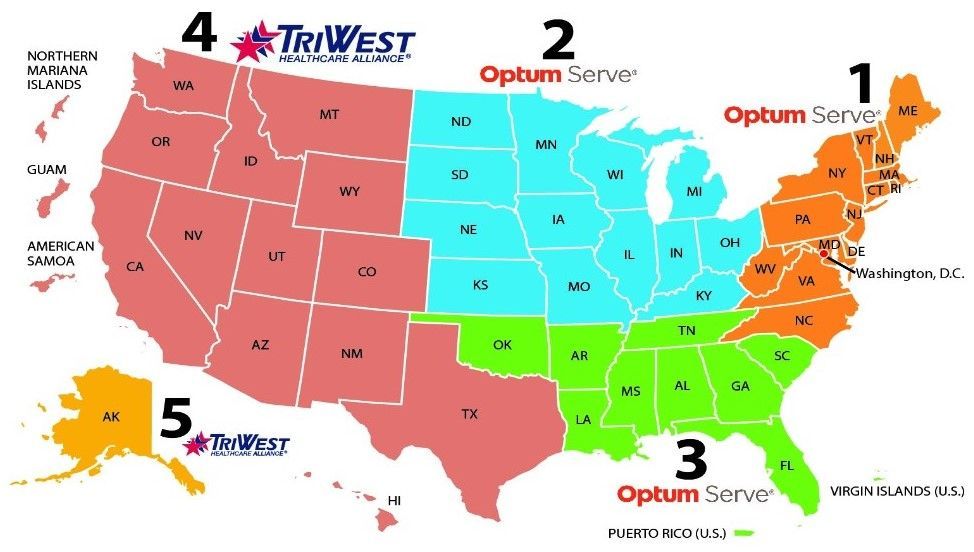
Each region operates with similar goals but may vary slightly in implementation timelines, provider saturation levels, and credentialing wait times. Credentialing can take anywhere from 6–12 months, depending on location.
2.2History and Overview
Evolution from the Veterans Choice Program to CCN
The VA first expanded Veteran access to non-VA care in 2014 with the Veterans Choice Program (VCP), born out of long wait times and access issues in the VA system. VCP allowed Veterans to seek community care under certain conditions, but lacked operational consistency. Providers faced reimbursement delays, fragmented communication, and confusing paperwork. Many exited the program entirely.
Overview of the MISSION Act and Its Impact
In 2018, Congress passed the MISSION Act, which replaced the Choice Program with the Community Care Network (CCN). The Act restructured access rules, centralized operations, and introduced private sector TPAs (namely Optum and TriWest) to manage credentialing, authorizations, and claims processing.
The MISSION Act also clarified eligibility criteria, improved scheduling coordination, and aimed to reduce red tape for both Veterans and providers.
Key Goals of the VA Community Care Network
The VACCN was designed to:
- Expand Veteran access to quality community care
- Ensure faster and more consistent reimbursement for providers
- Standardize billing, credentialing, and authorization workflows
- Offload administrative burden from VAMCs to specialized TPAs
2.3Agency Eligibility & Getting Started
The opportunity to serve Veterans through the VA Community Care Network (VACCN) is significant but it’s not open to just any agency. Before an organization can begin receiving referrals or billing the VA, it must meet specific operational, regulatory, and strategic criteria.
Delivering care through the VA is different from serving private pay or Medicaid clients. It requires an elevated standard of compliance, documentation, and procedural discipline. Before entering the VA space, home care agencies need to complete an honest readiness assessment.
Licensure, Certification, and Compliance Requirements
To serve Veterans under the VACCN, your agency must:
- Hold an active home care or home health license in your state. If your state requires this.
- Maintain liability insurance. Usually $1m per accordance, 3M aggregate.
- Have RN oversight capacity for Homemaker/Home Health Aide (HHA) services in states which require this.
Credentialing through Optum or TriWest will require documentation of all of the above, possibly with along with:
- Proof of service delivery policies and procedures
- Background check protocols
- Emergency preparedness plans
- Clinical supervision structure (if applicable)
Readiness Assessment: Staffing, Training, and Infrastructure
The most common service types authorized under VA are:
- Homemaker/Home Health Aide (HHA) care (non-skilled)
- Respite Care for caregivers
That means your agency should have:
- A pool of trained personal care aides with availability during standard and flexible hours
- At least one Registered Nurse on staff to perform initial assessments and provide oversight
- A system to handle documentation, timesheets, shift verification, and claim tracking
You must also be equipped to handle the operational demands of working with the VA:
- Timely filing (within 180 days)
- HCPCS code-level billing accuracy
- Pre-service verification of authorizations and eligibility
- Secure digital systems for storing referrals, authorizations, and clinical notes
2.4Enrollment & Credentialing
Becoming a VA-authorized provider under the Community Care Network (CCN) is a strategic move but it’s also a rigorous process. From background checks and compliance documentation to third-party administrator (TPA) portals and revalidation schedules, each step must be executed with precision.
This guide walks home care providers through the complete VA enrollment and credentialing process, highlighting common pitfalls and how to stay in good standing once approved.
Overview of the VA CCN Enrollment Process
Whether you’re working with Optum or TriWest, all VA provider enrollment follows a structured, multi-stage process designed to ensure the safety, quality, and compliance of care delivered to Veterans.
Required Documentation and Forms
To begin enrollment, your agency will need to prepare a complete package of credentials and policy documents. These typically include:
- State license for home care or home health (active and in good standing)
- Certificate of insurance (general liability, workers’ comp, professional liability)
- Business entity documents (EIN, Articles of Incorporation, W-9)
- Signed participation agreement (specific to Optum or TriWest)
- Staff roster with employee qualifications and roles
- Clinical oversight plan (especially for RN-supervised services)
- Policies and procedures (e.g., infection control, patient rights, documentation standards)
Background Checks, Accreditation, and Compliance
Depending on your region and services offered, TPAs may also request:
- Employee background check procedures
- OIG exclusion list screening policies
- CPR certifications
- Driver’s license records (for mobile field staff)
- Accreditation status (optional for home care, but required for some skilled services)
In short, they want to see that your agency is operationally clean, clinically sound, and administratively ready to engage with a federal payer.
Tip: Make sure your policies are not just internal documents, they must be in standardized, shareable formats ready for submission and audit.
Registering with Third-Party Administrators (TPAs)
The VA contracts with two TPAs to manage provider enrollment, credentialing, billing, and claims processing within the CCN:
- Optum – Regions 1, 2, 3 (East/Central U.S.)
- TriWest – Regions 4, 5 (West/Alaska)
Registering with Optum (Regions 1, 2, 3)
- Visit the Provider Portal: https://provider.vacommunitycare.com
- Select “Join the Network” and complete the online interest form.
- Submit a formal application once contacted by a network representative.
- Upload documentation including:
- State license
- Proof of insurance
- Completed provider agreement
-
- Complete credentialing screening through Optum’s delegated credentialing vendor.
- Set up your provider profile once approved.
Note: The Optum process is largely digital and self-managed, but response times vary depending on your region’s saturation level.
Registering with TriWest (Regions 4, 5)
- Go to the TriWest CCN Page: https://www.triwest.com/en/ccn/
- Submit your provider interest form.
- Expect follow-up from TriWest’s credentialing contractor (e.g., Aperture or CAQH).
- Provide documentation including licensure, insurance, and signed agreement.
- Complete any necessary training or orientation as required by TriWest.
- Access the TriWest portal to receive referrals and process claims once approved.
Reminder: Credentialing under TriWest can take 6–12 months, so plan ahead and stay responsive.
Common Credentialing & Enrollment Pitfalls
Incomplete Applications
Most delays in VA credentialing come from missing or incorrectly formatted documentation. Be sure to:
- Include all required attachments
- Use legible PDFs (no screenshots or photos of paperwork)
- Clearly label each file
- Review your submission checklist before finalizing
Verifying Licensure
TPAs verify licensure directly with state boards. If your license is under renewal or pending an update, credentialing will stall. Always confirm that:
- Your license is active and up to date
- Your license address matches your application address
- Your agency name and license name match exactly
How to Track Application Status
Both Optum and TriWest allow you to contact provider support teams to check your application progress. Best practice:
- Record the date you submitted your packet
- Keep the name and contact info of your onboarding representative
- Follow up every 3–4 weeks with a polite, concise status check
Internal tracking tip: Use a simple spreadsheet to log submissions, dates, documents provided, and contact history. This ensures accountability across your team.
Maintaining Active VA Provider Status
Credentialing doesn’t end when you’re approved. Ongoing participation in VACCN requires continuous compliance and proactive updates.
Revalidation Schedules & Recredentialing Intervals
- Most TPAs conduct recredentialing every 3 years
- Some services or locations may require annual attestations
- You will be asked to re-upload licenses, insurance certificates, and updated rosters
Miss a deadline, and you may be frozen from receiving authorizations until resolved.
Reporting Changes
If your agency undergoes any material change, you must report it within the required timeframe. This includes:
- Business address updates
- Ownership changes
- New administrators or clinical leads
- Changes in licensure or insurance carriers
Failing to report changes can lead to payment holds or even deactivation from the network.
Continuing Education Requirements
While there is no federal CEU mandate for home care aides, the VA and TPAs often require:
- RN supervisors to meet continuing education standards
- Documentation of caregiver training hours
- Periodic in-service training (especially around infection control, emergency protocols, and documentation)
Keep records of all caregiver training in a shareable format, ready for audit at any time.